
Massachusetts Bench Warrants Explained
State court guidance usually labels the missed-court process a "default warrant." People say "bench warrant" too, especially for a criminal arrest warrant that follows a nonappearance. Neither label points to its own database. Both simply point back to the underlying case and the issuing court in Massachusetts. A default warrant can follow a missed criminal date, a jury-duty default, or the failure to obey an order or contempt summons. Traffic and ordinance cases may take separate civil or criminal paths. In contempt matters the Massachusetts Probate and Family Court may issue a "capias," which is not a catch-all unpaid-fine warrant. A money-only default warrant for covered court debt follows its own statutory route, distinct from a missed criminal appearance. Massachusetts has no Justice of the Peace tier and no town-court network for warrants. Pin down the right Trial Court department and ask the clerk what the docket shows about the warrant.
Massachusetts Default Warrants After Missed Court
Massachusetts has two labels for the same missed-court event. The Trial Court glossary calls it a bench warrant, while public guidance more often says default warrant. Neither one means the court filed a new charge just for the failure to appear. A recall withdraws the warrant. A quash sets the process aside. A capias orders a person into court and can show up in Massachusetts civil-contempt or support matters. "Capias pro fine," though, is not a general JP or town-court warrant category; the Massachusetts Trial Court glossary spells out these terms.
- Default warrant
- Massachusetts warrant process after a qualifying court default.
- Bench warrant
- Common term for an arrest warrant after criminal nonappearance.
- Recall
- The Massachusetts issuing court withdraws its warrant and records the change.
- Capias
- Massachusetts process for some civil-contempt matters, not a general unpaid-fine warrant.
- FTA
- Failure to appear; a Massachusetts missed court date that may lead to a default or warrant depending on the case.
How Massachusetts Bench Warrants Are Issued
A Massachusetts bench or default warrant begins in the court already handling the case. Miss a criminal court date or break a condition, and a judicial officer may issue process under the applicable rule. A new-complaint arrest warrant is different. That one needs probable cause. Public dockets sometimes list a bench-warrant event, while WMS keeps the active-warrant data restricted. Once a warrant issues, the Massachusetts clerk logs it and the assigned police department in WMS. That agency serves the paper but cannot recall it. Only the court can do that, and the clerk then records the recall or removal for CJIS transmission. No public status table or universal update timeline exists. Section 23A is the statute behind this warrant-record system. Where you file depends on the court: Massachusetts District Court runs 62 divisions, Boston Municipal Court has eight covering Boston and Winthrop, and Superior Court has 14 county-based locations for indictment-level cases. Juvenile, Housing, and Probate and Family Courts can also issue warrants, with tighter record-access limits.
Massachusetts Default-Warrant Recall Assessment
Recalling a Massachusetts default warrant can carry a cost. General Laws c.276 §30 sets a $50 assessment at recall, waivable for good cause or substantial financial hardship. A separate $75 fee applies when someone is arrested on a warrant issued for default, forfeited bail, or probation surrender. That one goes to the arrest municipality and may also be waived under the statute. Neither charge applies in every case, so ask the issuing court which warrant fees fit yours. The official Massachusetts c.276 §30 states the recall fee and its waiver standard.
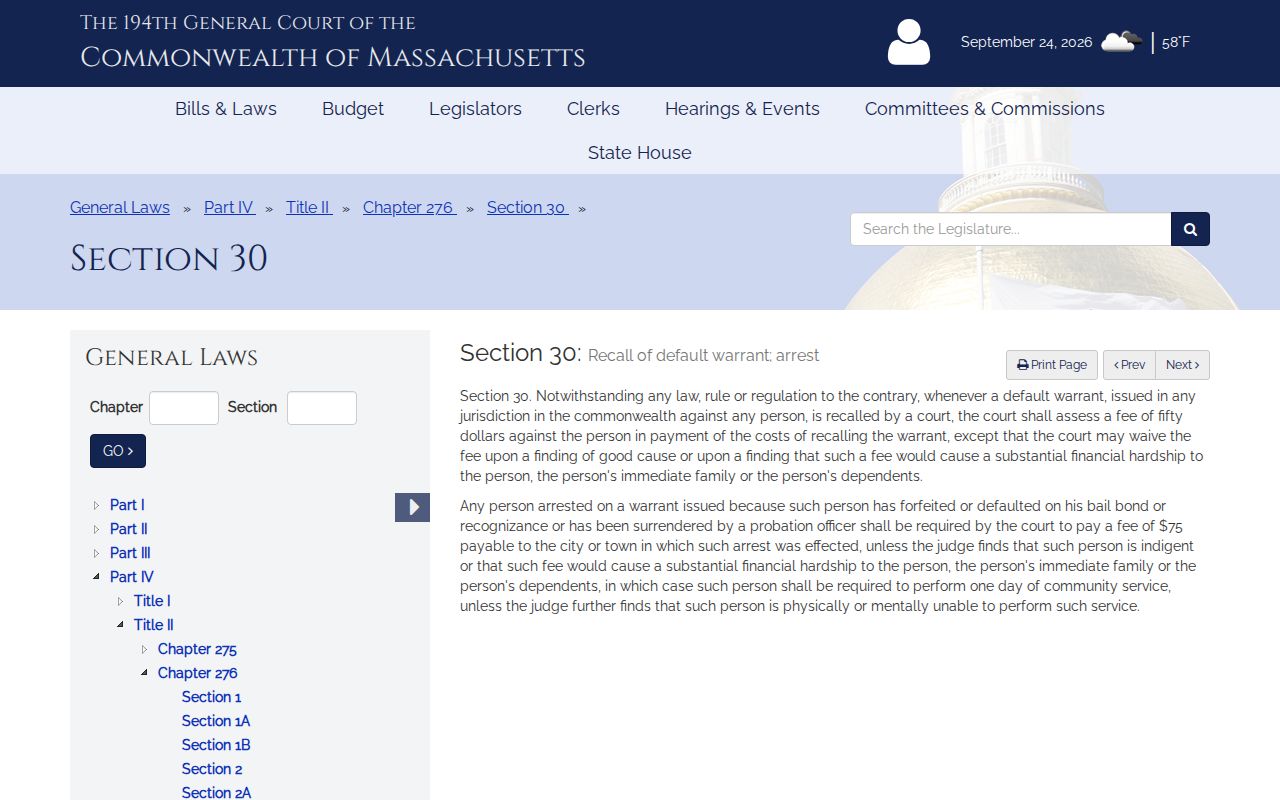
The Massachusetts default-warrant fee only applies in specified cases. It is not a bond schedule. Nor is it a rule that every bench warrant can simply be paid away. Note: Massachusetts default-warrant recall assessments depend on the warrant basis and any court-approved waiver, and they are separate from bail.
Bench and Arrest Warrants Compared
A Massachusetts bench or default warrant answers a no-show or a broken condition in an existing case. An arrest warrant answers something else: a criminal complaint plus a judicial probable-cause finding. "Bench" is not its own court tier. Both warrant types can land in WMS, but their triggers and next steps differ.
| Feature | Bench Warrant | Arrest Warrant |
|---|---|---|
| Trigger | Missed appearance or default in a pending Massachusetts case | Sworn Massachusetts criminal complaint and probable cause |
| What it addresses | Return to or compliance with the existing bench-warrant case | Bringing a defendant before court on the new arrest-warrant complaint |
| Record authority | The Massachusetts court that issued the default warrant | The judicial officer and court authorizing the arrest warrant |
| Resolution | Ask the Massachusetts court about appearance, recall, or eligible default-warrant payment | Ask about appearance, release, or arrest-warrant bail terms |
For a separate Massachusetts probable-cause case, see the arrest warrant search.
Massachusetts Quick Pay Does Not Remove Warrants
Paying online does not recall a Massachusetts warrant. Trial Court Quick Pay takes eligible payments, yet its own instructions say online payment does not remove an outstanding warrant and a court visit is required. A receipt proves nothing about recall being entered in WMS. There is one narrow exception. For a qualifying money-only default warrant, c.276 §31 covers specified fines, assessments, costs, restitution, or support, and the court may approve mail, telephone, or electronic payment of the stated balance plus $50. The warrant is then discharged, WMS is updated, and notice goes out within seven days. Section 32 governs the situation where the person is brought before the court and permits release if no other process remains. Ask which Massachusetts warrant record confirms discharge. Traffic citations are separate: paying through the RMV or a Massachusetts court does not confirm warrant recall, and license or registration effects may persist, so contact the issuing clerk and the RMV about their own records. Note: payment and recall are separate actions in Massachusetts, even for the same default.
Resolving a Massachusetts Bench Warrant
Massachusetts sets no single walk-in, bond, or recall rule that covers every bench warrant. Each court handles its own. Call the issuing Clerk-Magistrate or clerk and ask why the warrant issued, whether it is still active, and whether a judge must act. Find out what appearance or payment is allowed. A motion to recall or remove a default may fit, since filing and session practices vary across Massachusetts, and counsel can help arrange an appearance.
- Identify the Massachusetts court and division from a notice, docket, citation, or bench-warrant case origin.
- Ask the Massachusetts clerk for active bench-warrant status, the next session, and whether a judge or magistrate must hear it.
- Confirm whether a planned Massachusetts walk-in is accepted; there is no universal walk-through rule.
- Ask whether a money-only default warrant qualifies for c.276 §§31-32 or needs another recall route.
- Attend as directed and obtain Massachusetts docket proof of bench-warrant recall.
- Confirm the Massachusetts clerk entered the change in WMS; handle RMV effects separately.
Caution: Do not assume a bench warrant expired or that online payment cleared it. Ask the Massachusetts issuing court to confirm status and next steps.
Massachusetts Jury-Warrant Resolution
Jury duty has its own warrant route in Massachusetts. Contact or visit the issuing court's Clerk-Magistrate, explain the default, and follow the directions on review or proof. It is narrower than a criminal bench warrant. It does not cover a missed criminal session or traffic date. Ask the Massachusetts clerk what documentation the court expects. The official Massachusetts jury-warrant instructions lay out that route end to end.
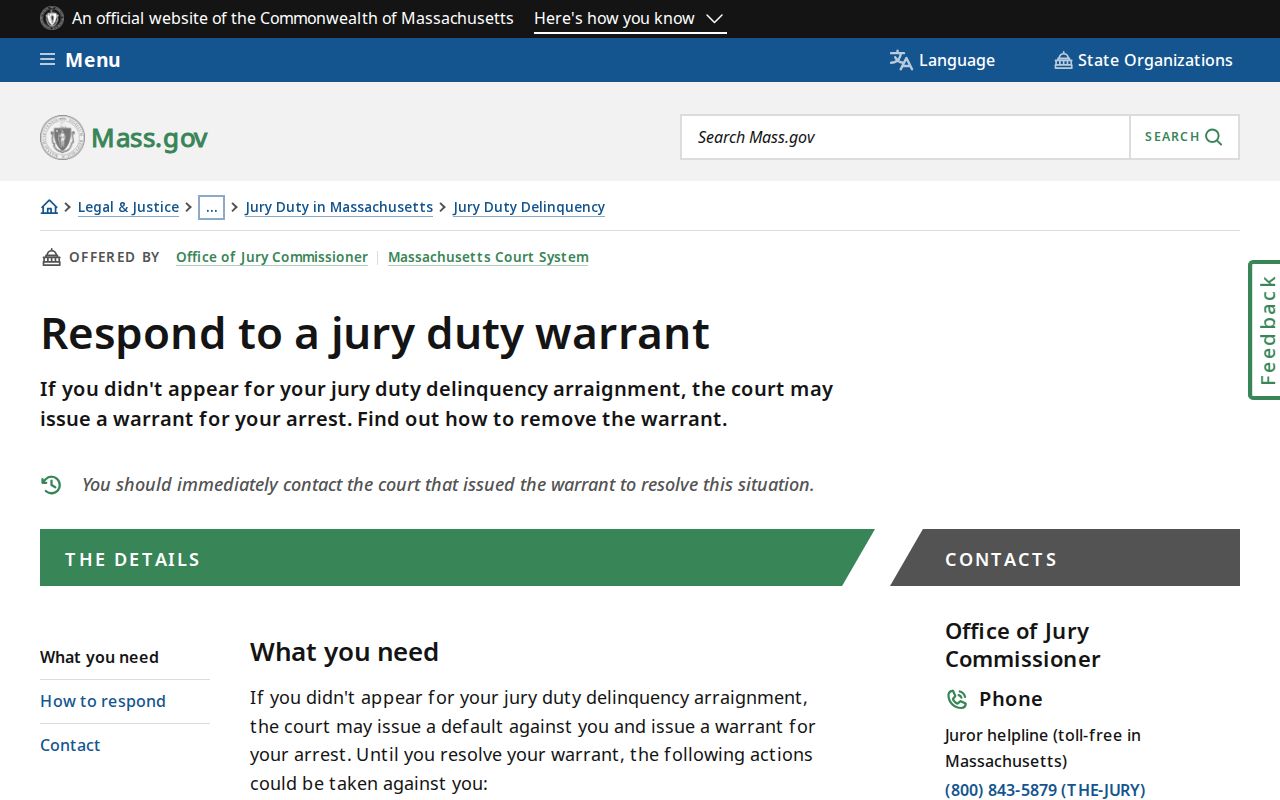
Note: Massachusetts jury-default instructions do not govern every bench warrant. Ask how the court records removal of the default. That page is no bench-warrant search form.
Finding the Court That Issued It
A Massachusetts bench warrant belongs to the case that produced it, not to your current address or county. The unified Trial Court sorts matters by subject. District Courts and the Boston Municipal Court handle many criminal and ordinance cases. Superior Court takes indictment-level matters. Juvenile, Housing, and Probate and Family Courts can issue process within their own jurisdictions. Some of their records carry extra access limits. There is no JP warrant database in Massachusetts. No general municipal-court network either. "Municipal Court" here means the Boston Municipal Court department, with eight divisions serving Boston and Winthrop. Town ordinances elsewhere generally go to District Court's 62 divisions. Use the Massachusetts Trial Court courthouse finder to pinpoint the division, then the county directory for local court and sheriff resources.
| Court level | Massachusetts warrant context | First record contact |
|---|---|---|
| District Court | Massachusetts criminal, traffic, ordinance, and default-warrant matters | Massachusetts Clerk-Magistrate or Assistant Clerk-Magistrate |
| Boston Municipal Court | Boston and Winthrop matters within its jurisdiction | BMC Clerk-Magistrate or Assistant Clerk-Magistrate |
| Superior Court | Indictment-level criminal cases and bench-warrant process | Clerk of the Superior Court, criminal business |
| Juvenile, Housing, Probate and Family | Warrants within subject jurisdiction; access rules vary | Department clerk or Register, as applicable |
County links point to local resources only. Reach for them once the right Massachusetts court is known.
Massachusetts Bench-Warrant Steps After Missing Court
Missed a Massachusetts court date? Confirm whether the court issued a default warrant or another order. Docket entries alone prove nothing about live WMS status. Use the notice or docket number to find your division, then ask the clerk which session handles the bench-warrant case, whether a judge must review the reason, and whether counsel should arrange an appearance. A civil traffic default is not an arrest warrant. In Massachusetts, civil motor-vehicle matters usually start with a response and an RMV notice. A later contempt summons and a failure to appear can trigger default-warrant process. Criminal motor-vehicle cases follow a different path with separate RMV effects. Massachusetts sets no statewide bench-warrant bond schedule, walk-in promise, or recall form. Ask what payment, appearance, or motion applies. Get confirmation once the clerk records the recall. Police or sheriff staff may serve process. Only the issuing court can withdraw its warrant.