
Inside the Massachusetts Warrant System
Massachusetts runs one unified Trial Court rather than a stack of county courts. Seven departments make it up. District, Boston Municipal, Superior, Juvenile, Housing, Probate and Family, and Land each carry their own caseload. District Court alone has 62 divisions. Boston Municipal Court adds eight for Boston and Winthrop. Where a Massachusetts warrant is filed depends on which division holds jurisdiction, not on county lines alone, and the Massachusetts court-system information page lays out that structure. Under M.G.L. c.276 §23A, the Trial Court keeps the Warrant Management System, known as WMS. Clerks enter each Massachusetts warrant record there along with the police department assigned to serve it. Authorized law-enforcement users and the RMV reach that warrant information through CJIS. Police, sheriffs, and other Massachusetts officers can serve process. Recall, though, stays with the issuing court. Massachusetts has no municipal-court network or Justice of the Peace tier; town ordinance cases go to District Court, and Probate and Family Court contempt process sits apart from an ordinary criminal warrant and its WMS record.
Massachusetts Warrant Management System at Trial Court
WMS is a statutory court system, not a public warrant website. Massachusetts built it for internal use. Section 23A lists what each warrant record holds: identifying details, offenses and classification, aliases, justice data, and the assigned serving department. Those fields never become public warrant-search fields. When a Massachusetts warrant is recalled or removed, the clerk records the change for CJIS transmission without unnecessary delay. A docket event adds case context. Only the Massachusetts issuing court confirms active warrant status, and the Massachusetts WMS statute sets the legal frame for these warrant records.
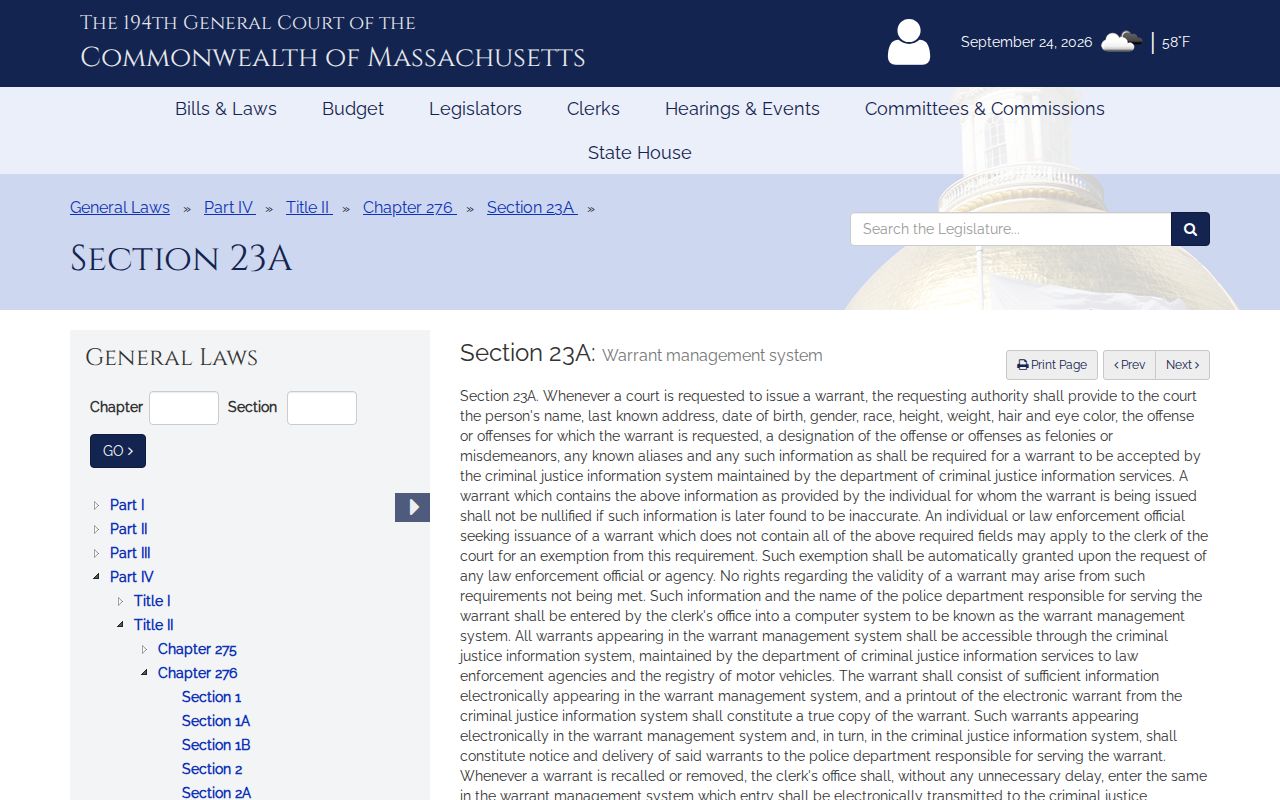
The Massachusetts statute page sets out the restricted, court-maintained basis for WMS access. Note: A serving police department is not the issuing court and does not control recall.
Massachusetts Statewide Warrant Databases
Massachusetts warrant information sits in several separate systems. The table compares WMS warrant records, restricted CJIS access, public MassCourts dockets, RMV tools, and the federal NCIC index, each with its own users and roles.
| System | What It Holds | Run By |
|---|---|---|
| Warrant Management System (WMS) | Trial Court arrest and default warrant entries; no public query form | Massachusetts Trial Court under c.276 §23A |
| Criminal Justice Information System (CJIS) | Restricted warrant-record access and transmission for authorized criminal-justice users | DCJIS administers Massachusetts CJIS infrastructure and access rules |
| MassCourts | Public Massachusetts case and docket records, subject to court access rules | Massachusetts Trial Court |
| RMV citation tools | Traffic-ticket payment and vehicle privilege steps, not a warrant list | Registry of Motor Vehicles |
| National Crime Information Center (NCIC) | Law-enforcement Wanted Person File; not a public search and not an automatic copy of every WMS record | Federal Bureau of Investigation |
These systems do not add up to one public Massachusetts warrant search. Nothing guarantees every WMS warrant reaches NCIC. The issuing court controls each state warrant record. MassCourts may show public docket events, but it returns no active-warrant result. RMV citation payment and license records sit apart from WMS, while CJIS and NCIC warrant indexes stay restricted to authorized users. One system's result is not a full search of the others across Massachusetts.
Massachusetts State Police and Warrant Management
The Massachusetts State Police do not own WMS. The Massachusetts Trial Court maintains it, and DCJIS administers CJIS access. MSP's Violent Fugitive Apprehension Section assists police agencies with fugitive work, and MSP also runs a curated Most Wanted tip program. Those roles stay separate. An MSP public-records request covers only records MSP holds, not the Trial Court's Massachusetts warrant record or active status. For a personal warrant check, ask the issuing court clerk.
Massachusetts State Police VFAS
Statewide fugitive liaison and operations section. Its official page provides current unit information.
The Massachusetts DCJIS page describes the CJIS agency.
The screenshot shows an agency page, not a WMS query or warrant record.
How Massachusetts County Warrants Reach the State
Each Massachusetts warrant begins in the division with jurisdiction. The clerk enters the warrant record and its serving police department in WMS under §23A. Authorized users and the RMV query CJIS.
Massachusetts warrant flow: Trial Court division › clerk enters WMS warrant record › authorized CJIS access for police and RMV › assigned agency serves process.
A Massachusetts clerk logs each recall or removal for CJIS. Massachusetts publishes no WMS coverage map, update schedule, or active-warrant total, and says nothing about every warrant entering the NCIC index. Service can fall to local police, sheriffs, constables, or State Police. Recall belongs to the issuing court. The Massachusetts county directory helps with local routing. Each warrant record carries a serving-department field. That field links the Massachusetts warrant to a service agency; it does not make the agency the issuing authority. The assigned agency can explain service logistics, while the Massachusetts court answers recall and case-status questions.
MassCourts Is Not a Massachusetts Warrant Search
MassCourts opens public Massachusetts case records, not the WMS warrant database. It is no live warrant register. Remote criminal searches in Massachusetts usually need an exact docket or case number, not a name. A blank Massachusetts docket does not clear a name. Courthouse terminals can offer broader name access to public records. Even those terminals do not query WMS. Juvenile, sealed, and impounded dockets carry their own limits, and Massachusetts offers no public WMS form, statewide warrant desk, or published active-warrant total.
Key point: MassCourts gives Massachusetts case and docket context; only the issuing court confirms whether its warrant record is active or recalled.
The Massachusetts docket search instructions explain the public record route. A Massachusetts clerk can confirm warrant status. Note: Massachusetts MassCourts dockets and WMS warrant records serve different users, access rules, and purposes.
Fugitive Warrants and the US Marshals
The U.S. Marshals Service handles federal arrest warrants, and its District of Massachusetts Fugitive Task Force pairs federal agents with state and local officers. Help from a partner does not federalize anything. When a Massachusetts officer works alongside the task force, the warrant stays a Massachusetts matter, and the issuing authority and charge never change. Federal warrants run on a separate track. A federal judge or magistrate issues them, and USMS serves them. Questions about that warrant record go to the federal court, your counsel, or USMS itself. A Massachusetts clerk cannot recall federal process. The U.S. Marshals fugitive investigations overview explains that separate role, and the two warrant systems and record sets never merge through a task-force partnership.
Massachusetts Federal Warrant Divisions
The U.S. District Court for Massachusetts splits into Eastern, Central, and Western divisions. That map only routes federal warrant cases. It sets no venue in the Massachusetts Trial Court and no state warrant service. PACER, meanwhile, is a public federal docket archive. It is not an active-warrant search or warrant index, and sealed or unexecuted process may not appear there. Identify the federal case in Massachusetts first, then ask counsel or the federal clerk about appearance steps. The federal divisions page lists each location and its jurisdiction.
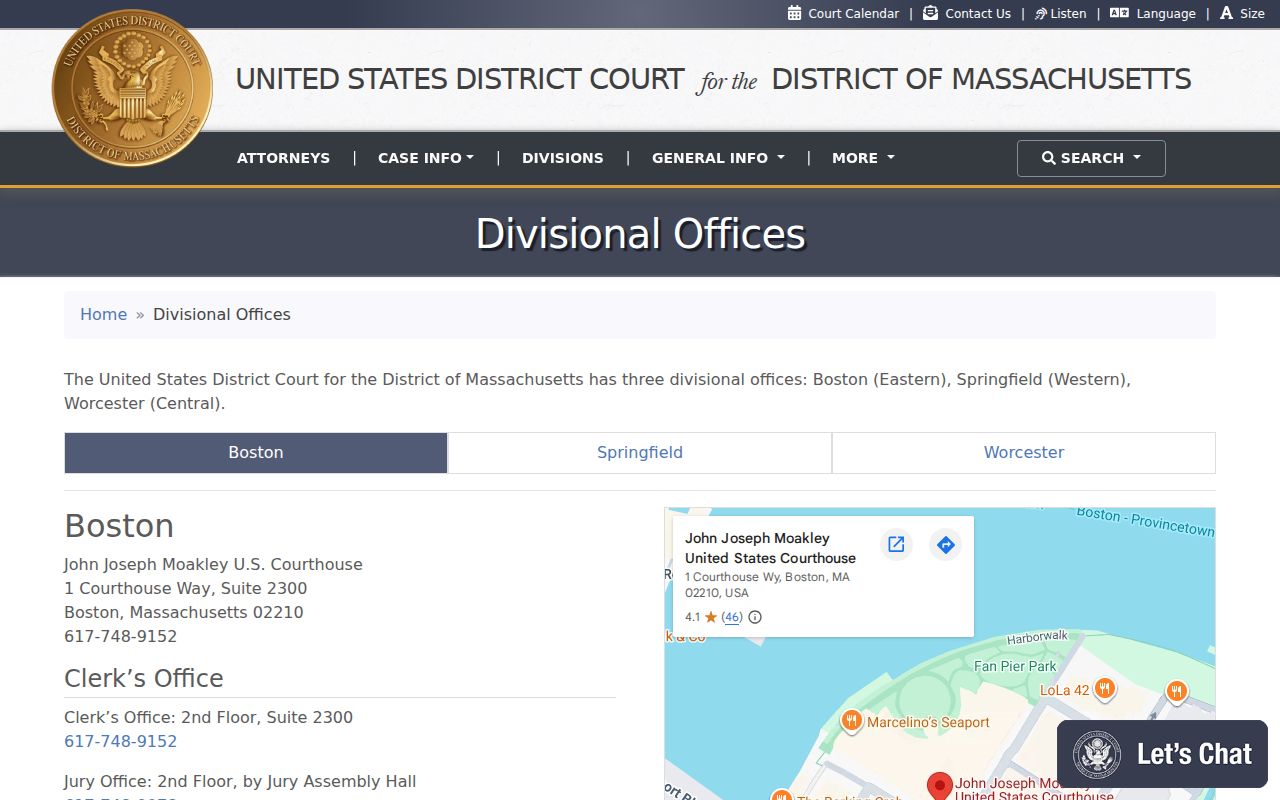
Federal warrant routing runs through these divisions, separate from Massachusetts Trial Court records and local service.
Massachusetts Statewide System vs County List
Massachusetts built WMS for authorized statewide agency access, not a public county-by-county warrant list. A local sheriff or police page may show fewer warrants. It may not exist at all. The issuing Massachusetts court still controls the warrant record and any recall.
| Feature | Massachusetts WMS | Local Sheriff or Police Page |
|---|---|---|
| Record source | Massachusetts Trial Court warrant entry under c.276 §23A | Local information an agency chooses or is authorized to publish |
| Access | Massachusetts courts, law enforcement through CJIS, and RMV for statutory uses | Public only where a local agency offers a warrant page |
| Coverage statement | No public Massachusetts warrant search, coverage map, or live total found | No statewide warrant catalog or shared local search was found |
| Recall authority | Massachusetts issuing clerk records recall or warrant removal | A local fugitive notice change does not recall court process |
Use the Massachusetts county directory to find a local agency. Then confirm warrant status with the issuing court. A local list never proves statewide absence. A blank Massachusetts sheriff page proves nothing. The state publishes no statewide catalog of local warrant systems or participation map, because an agency may simply post no fugitive list.
Massachusetts Warrant and RMV Systems Differ
M.G.L. c.276 §23B sets up a Massachusetts license match, not a public warrant search. Massachusetts licensing authorities send annual lists to DCJIS. DCJIS checks them against WMS default or arrest-warrant records. A match triggers written notice to the person. That notice gives 30 days to show the Massachusetts warrant was recalled or does not exist. The authority may then suspend the license. A hearing request is allowed within 90 days. Ask within 10 days, and suspension is delayed until a decision, which is due within 45 days. Those §23B notice and hearing periods cover the license match only, not every Massachusetts warrant. Massachusetts RMV traffic citations follow separate rules. Payment or license restoration never queries WMS and never recalls a court warrant. Check warrant status with the issuing Massachusetts court, and use the RMV ticket instructions for citation payment. These license and traffic systems involve different agencies, so a §23B match and an RMV record never travel together.
Massachusetts Warrant Technology and History
The Massachusetts Legislature created WMS in 1994 through St. 1994, c.247, §3, now reflected in c.276 §23A. It is a statewide Trial Court warrant database. Access belongs to authorized law enforcement, not the public. MassCourts came later. The Massachusetts Trial Court says WMS integration proceeds as implementation continues, with no completion date or full database migration period given. Public docket access has not loosened warrant-record restrictions. The statutory WMS warrant register and the public MassCourts docket layer therefore stay distinct, though linked. Massachusetts publishes no migration date or warrant index. A docket search, in short, cannot prove a complete warrant history.
Massachusetts Warrant Status Under 209A Guidance
A revision dated Oct. 20, 2025 to Massachusetts Trial Court 209A Guideline 5:07 tells a court to deal with any outstanding warrant before a defendant leaves an abuse-prevention hearing, when the rule applies. That workflow covers only that courtroom setting. It is no amnesty and no public WMS search. For your own warrant status, ask the issuing clerk; Massachusetts has no statewide amnesty, no public WMS form, and no published count of active warrants. Enforcement totals are limited measures, not a WMS balance. The Middlesex Sheriff reported 935 warrants cleared in 2025, and the USMS reported 335 cleared in Operation 250th. Neither figure covers all Massachusetts warrant records. The guideline itself spells out the hearing rule.