
Massachusetts Active Warrants Explained
In Massachusetts, a warrant stays open until it is served, recalled, or discharged. Active and outstanding are status labels. Neither one points to a public list you can search. The Trial Court's Warrant Management System, or WMS, holds arrest and default warrants statewide, but only authorized users can query it. Massachusetts publishes no count, no update time, and no results page for it. The issuing court owns the warrant record and the power to recall it. Service is assigned to a named police department, while the sheriff, a constable, or state police may join depending on local assignment. County lines create no sheriff registry here. MassCourts offers limited case context, and the Massachusetts State Police Most Wanted program is hand-picked. Neither one reveals every open warrant. A sheriff's page can describe service roles. It cannot certify the state's outstanding warrants.
Massachusetts Has No Public Active-Warrant List
Massachusetts publishes no statewide active-warrant list. There is no public outstanding-warrant search form either. The state's WMS system exists, but only authorized users reach it through CJIS. Most Wanted pages from the Massachusetts State Police cover selected fugitive cases, and local police notices run on their own. No county-level warrant search, refresh schedule, or completeness statement exists anywhere in the state. A blank search proves nothing; the issuing Massachusetts court can check its own record and explain how a warrant is recalled.
What a blank result means: Massachusetts offers no public WMS result; absence from a local or curated list does not clear an outstanding warrant.
How Massachusetts Tracks Active Warrants
M.G.L. c.276 §23A lays out the flow. A Massachusetts judicial officer issues the process. The court clerk then enters the warrant and the serving police department into WMS. Authorized users reach it through CJIS. The Massachusetts Registry of Motor Vehicles holds statutory access too. The record is court-held, not assembled from county websites. When Massachusetts recalls a warrant, the clerk records the change for CJIS transmission. A Massachusetts docket event is not live active-warrant status. No refresh interval, record count, county map, or backfill range is published. Note: No public WMS refresh schedule exists in Massachusetts, so a docket event alone cannot establish whether a warrant is still active.
Massachusetts Docket Results Cannot Confirm a Warrant
MassCourts is the Massachusetts Trial Court docket system, not WMS. Remote criminal searches demand an exact case number. Name search is for civil cases only. A record can show the division, parties, events, or disposition, but no guaranteed warrant flag exists. An empty Massachusetts result does not clear an outstanding warrant. Rule 5 draws the line between public docket access and a remote criminal-name search:
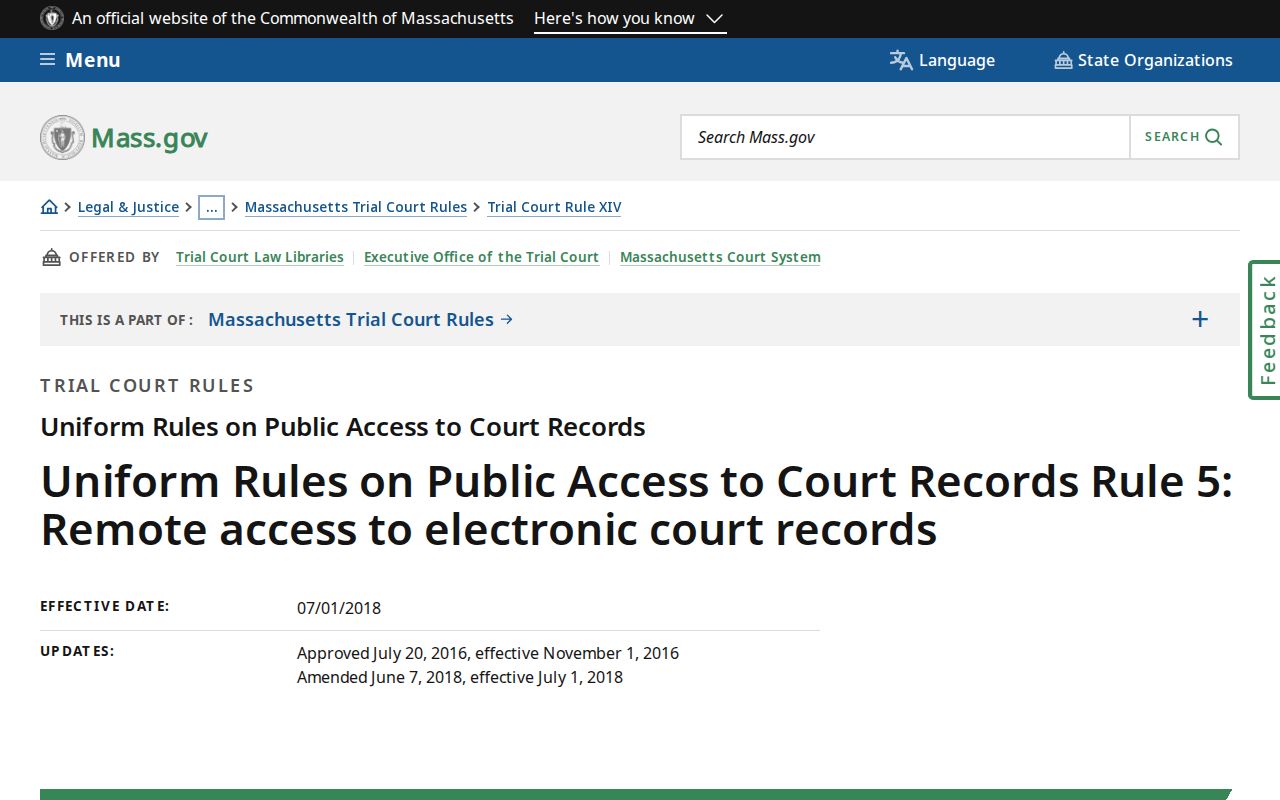
Remote limits shape how a Massachusetts case gets found. They say nothing about whether an active warrant exists. Massachusetts court staff can check the record they maintain. Rule 5's access rules never answer warrant status. Note: A docket match helps with context, but no match is not Massachusetts warrant clearance. A courthouse terminal may run a broader case-name search than the remote portal. The Trial Court's terminal access guide describes the public case information available there. That helps when the case number is unknown. It is still a case-record tool. It does not expose WMS or certify live status, so confirm with the issuing clerk.
Inside an Active Warrant Record
Massachusetts has no public WMS warrant-record schema. Section 23A describes internal Trial Court fields, not public search results. A docket may show a case detail or a warrant event. It will not carry an online warrant number, live status code, bond amount, or serving department. None of it is a live entry. The table separates statutory active-warrant data from public docket context, and it is not a sample listing of Massachusetts warrants.
| Identity fields | WMS lists name, last known address, birth date, physical descriptors, and aliases. These Massachusetts warrant fields are internal, not public search inputs. |
|---|---|
| Offense and class | The Massachusetts statute lists offenses and felony or misdemeanor class in the internal warrant record. |
| Serving department | The Massachusetts clerk names police for warrant service; that agency is not the issuing court. |
| Case number | A public docket may show the case number. Massachusetts publishes no WMS warrant-ID format. |
| Active or recalled | Plain-English warrant-status terms, not verified Massachusetts WMS codes. Ask the issuing clerk. |
| Bond or amount due | A public warrant record may omit bond or balance; ask the court what applies. |
The Massachusetts WMS statute describes internal fields, not public warrant results. Its identity data include physical descriptions and aliases, well beyond case numbers.
Most-Wanted Profiles Are Not Warrant Searches
The Massachusetts State Police Most Wanted program is a curated tip resource for selected fugitive cases. The Violent Fugitive Apprehension Section backs it. It is not WMS. A missing profile is no proof that a person has no warrant. The Massachusetts page offers no county selector, warrant-number search, or stated update schedule. Nor is it a complete outstanding-warrant list. State Police tell readers never to approach anyone or take action themselves. For tips, follow the official instructions; for your own warrant, contact the issuing Massachusetts court. The companion Massachusetts Most Wanted List guide explains the program in full. The official Massachusetts State Police page posts the profiles and the safety directions:
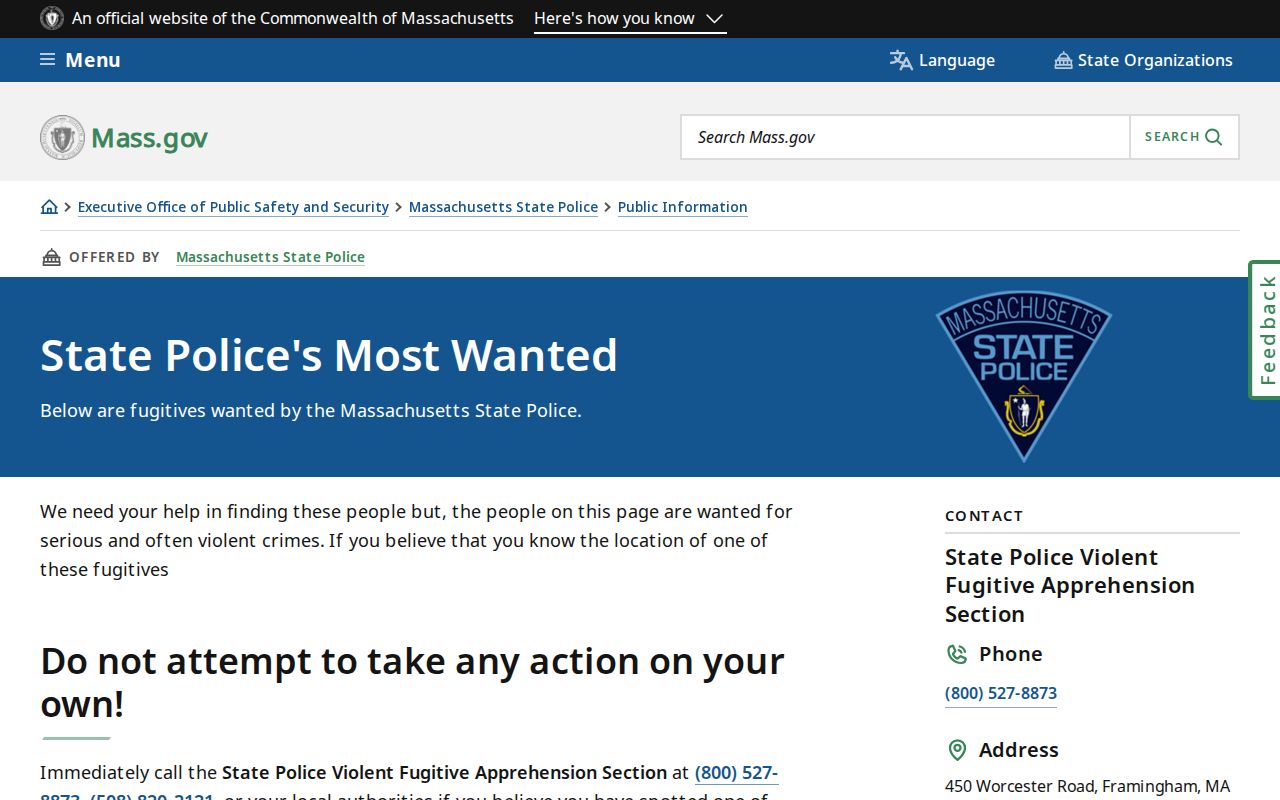
This is program information. It is not a Massachusetts warrant result or a complete outstanding-warrant record. Note: A Most Wanted profile does not mean other Massachusetts warrants are closed.
Warrant Roundups and Most-Wanted Lists
Massachusetts runs no statewide warrant roundup, amnesty hotline, or shared county index. No public portal covers every court and county warrant. Local police and sheriff notices stay separate. A Massachusetts warrant search therefore means checking each office's own page. Federal fugitive material sits apart from Massachusetts court records as well. The U.S. Marshals fugitive program posts selected federal notices, and PACER opens public federal dockets when a filing is not sealed. Neither tool adds up to a complete federal or Massachusetts warrant lookup.
Use the source, not a copied roster: The Massachusetts State Police Most Wanted page is the place for current notices and tip information.
| Public channel | Purpose | What it cannot confirm |
|---|---|---|
| MSP Most Wanted | Selected Massachusetts fugitive-tip program | All active warrants or a person's full status |
| Local police or sheriff notice | Local warrant information where published | Statewide coverage or another court's recall |
| Federal list or PACER | Selected federal notices or dockets | All federal or Massachusetts warrants |
Massachusetts WMS Warrant Records and Recall
Massachusetts WMS tracks changes to an active warrant. When a court recalls or removes one, the clerk enters that event for CJIS transmission. A public docket can lag behind the change. Online case access is not the operational warrant system. No live status screen or county update schedule is published. That WMS entry is the Massachusetts court's warrant-recall record, not a public list update. Massachusetts General Laws, chapter 276, section 23A describes WMS and the clerk's warrant-record entry role:
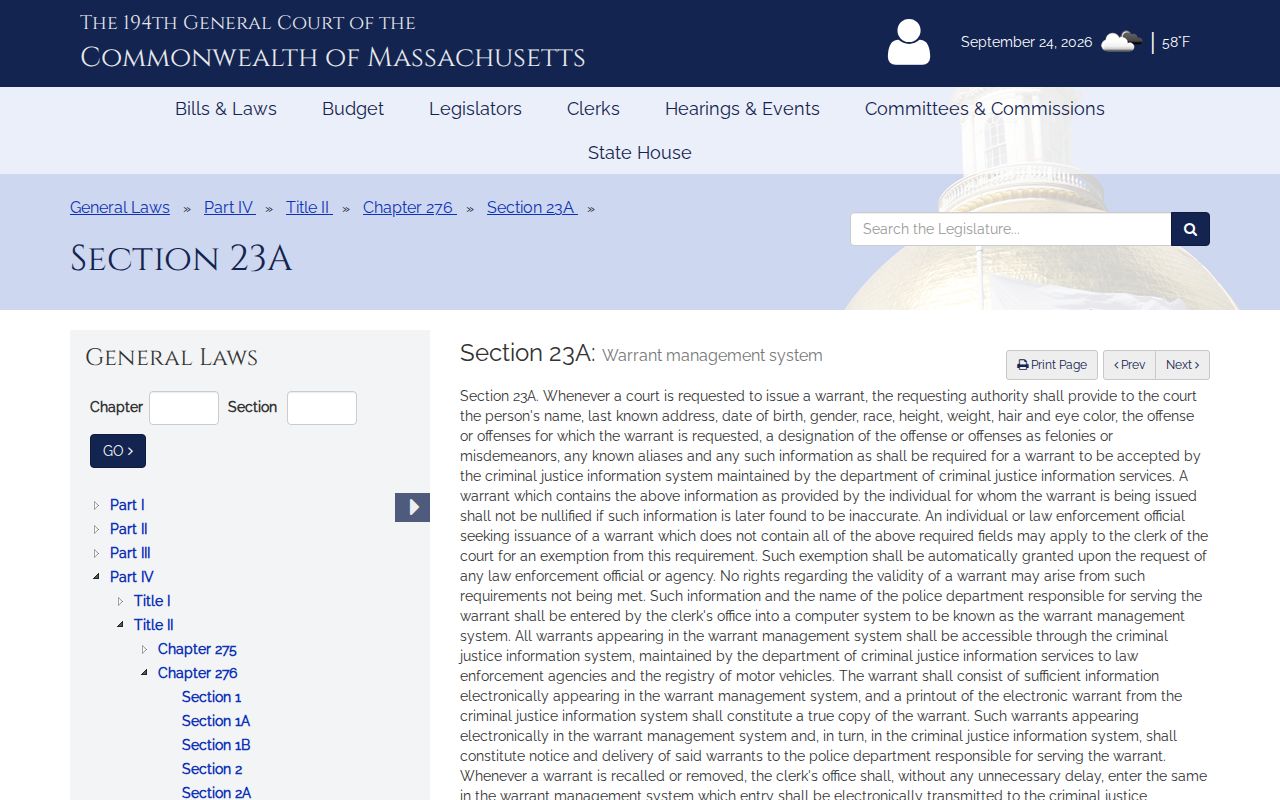
Ask the Massachusetts clerk whether the recall was entered and which court record shows the active warrant came off.
- Active or outstanding
- Plain-English terms for an open Massachusetts warrant; WMS codes are not public.
- Recalled
- The Massachusetts issuing court withdraws the warrant and records that change in WMS.
- Removed or discharged
- An authorized court action takes a warrant out of active status; qualifying money-only payment may apply.
- Serving department
- Police named to execute a warrant, not necessarily its court record custodian.
When Your Name Is on the Warrant List
Seeing a Massachusetts name on a fugitive page calls for official instructions, never a personal approach. For your own status, ask the issuing Clerk-Magistrate or clerk directly. Is the warrant active? What obligation remains? Which session handles recall? If you cannot tell which Massachusetts court issued it, the courthouse finder pinpoints the building. Ask whether a judge must act before any appearance you plan, and whether payment or counsel is needed for that warrant. Police or sheriff staff can explain service, but only the Massachusetts court can recall its process. The county directory routes you to local court and sheriff resources.
For a confirmed warrant: Speak with the issuing clerk or an attorney about status, appearance, and release terms before arranging a walk-in or surrender.
Confirm Massachusetts Warrant Status at Court
A blank Massachusetts search result proves little on its own. First figure out what you searched: a docket, a fugitive page, or a local notice. Each is narrower than an active-warrant check. The MassCourts name search does not reach remote criminal cases, and sheriff coverage varies by county. None of it replaces the issuing court's record.
- Gather the case name, birth date, docket or citation number, notice, and approximate court date.
- Ask the Massachusetts issuing clerk to confirm current active-warrant status.
- Confirm the required appearance, recall motion, payment, or proof; no single walk-in rule covers every case.
- Ask which agency handles warrant service, separate from the court's recall decision.
- After court action, confirm WMS entry. Check the RMV separately for citation or driving-privilege effects.
Keep three things separate. Massachusetts warrant status, local service, and any RMV account are different records. The Massachusetts court's WMS warrant entry is not an RMV update. For a federal warrant, contact the federal court or counsel, since public dockets may omit sealed or unexecuted process.